


Workshop: How to create an acoustically good studio with natural materials?
During the course, we learned how to create a wall of straw bales between timber frames, and in the process, we learned the different straw house building techniques. The weekend was full of activities and hands-on tasks.
A building adventure in Viimsi
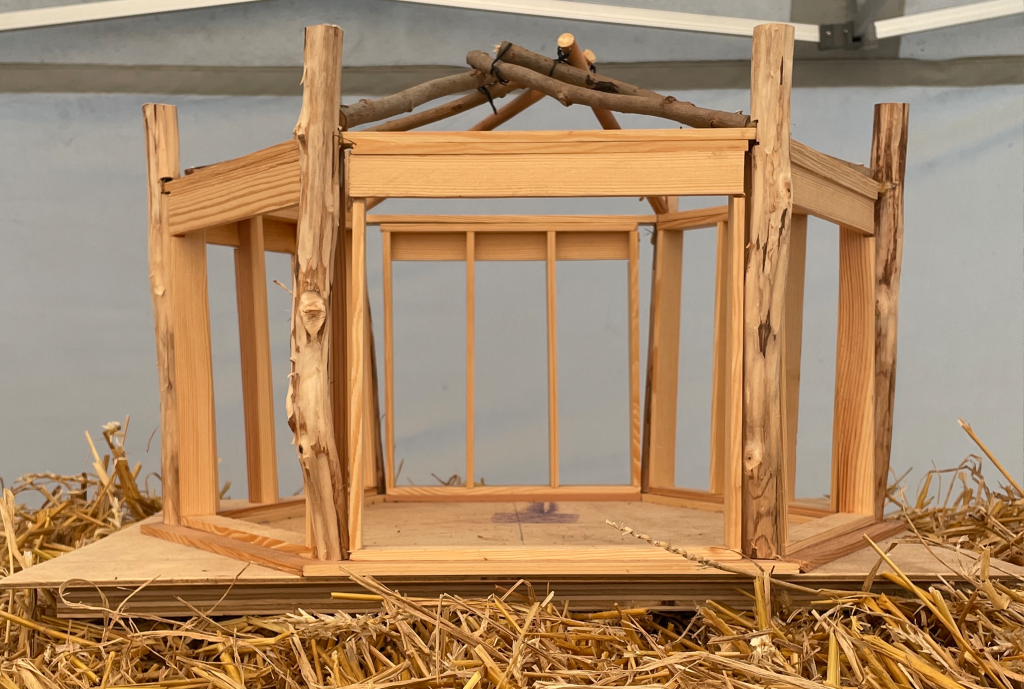
The practical part of the workshop took place in Viimsi, where the site on which we installed our main house was located. The object was a studio in the backyard of a resident’s home, where various tea and music ceremonies were planned. Perhaps you wonder why a straw studio? The client’s goal was to build something special, a house with an interesting form, and at the same time experiment with greener building technology.
The client arrived at the idea for the straw building through two important factors. Firstly, he wanted the house to have a distinctive shape, something more than a standard rectangular building. Secondly, he was interested in environmentally friendly construction methods. While doing his homework, he became familiar with building from straw and decided to attend a course on straw house building. This course reinforced his conviction that a combination of straw walls and a mandala roof was exactly what he needed. A mandala roof is a roof where each truss supports the previous one. The result is a strong self-supporting structure.
The strength and fire resistance of straw bales
An interesting nuance about this project was that the owner built the foundation and completed the wall and roof structures after attending the training. And then a problem then arose – obtaining planning permission from the municipality took longer than originally planned. The problem was that the studio and the neighbour’s shed had a fire barrier of less than 8 metres, and current regulations required the walls of the studio to be made of fire-resistant material.
This year a terrible incident happened to the straw chapel. It was maliciously set on fire in the spring of 2023 and was described in the news as completely destroyed. In fact, the wooden structure of the chapel was burnt, but all the straw packs were preserved, which were delivered to the same studio owner’s property. The studio builder’s idea was to reuse these straw packs. This incident became a convincing argument to the fire safety specialist that the straw walls are sufficiently fireproof.

Large straw packs and their processing
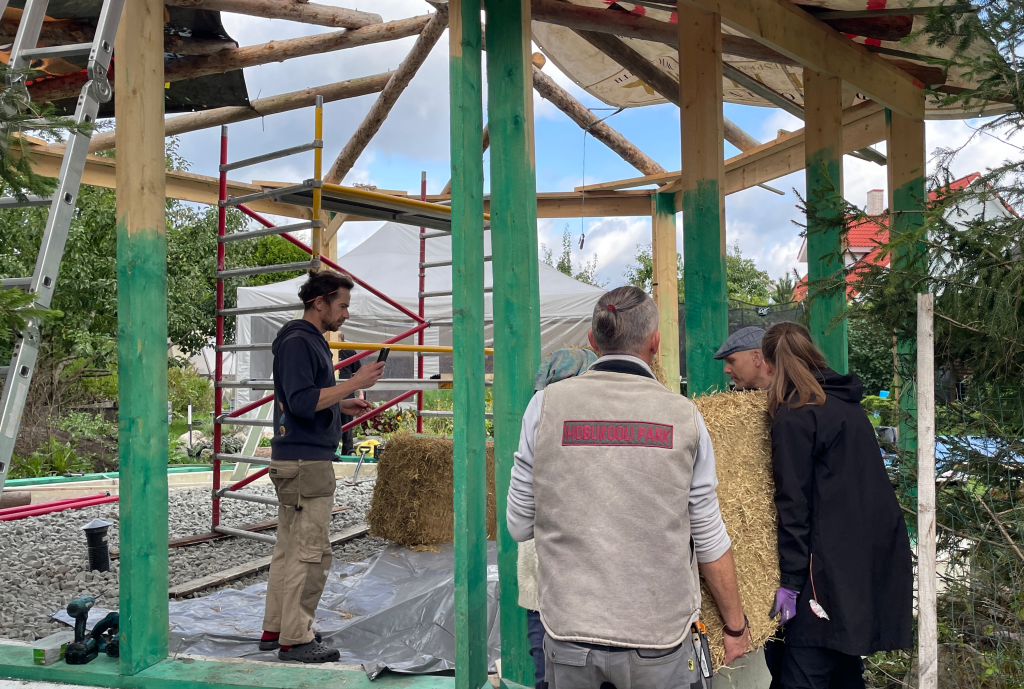
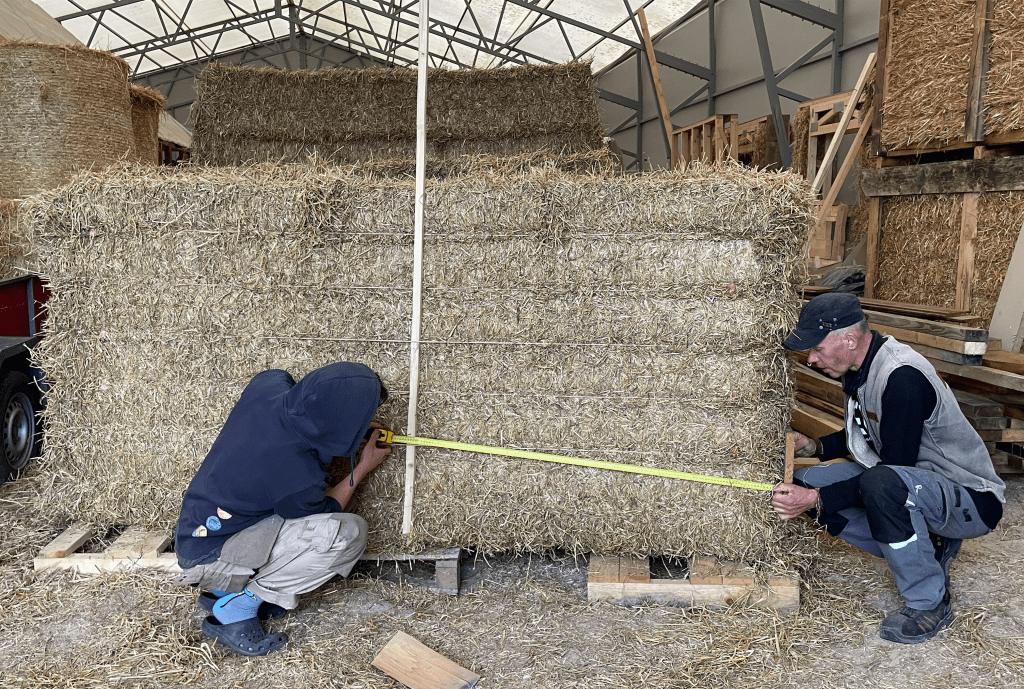
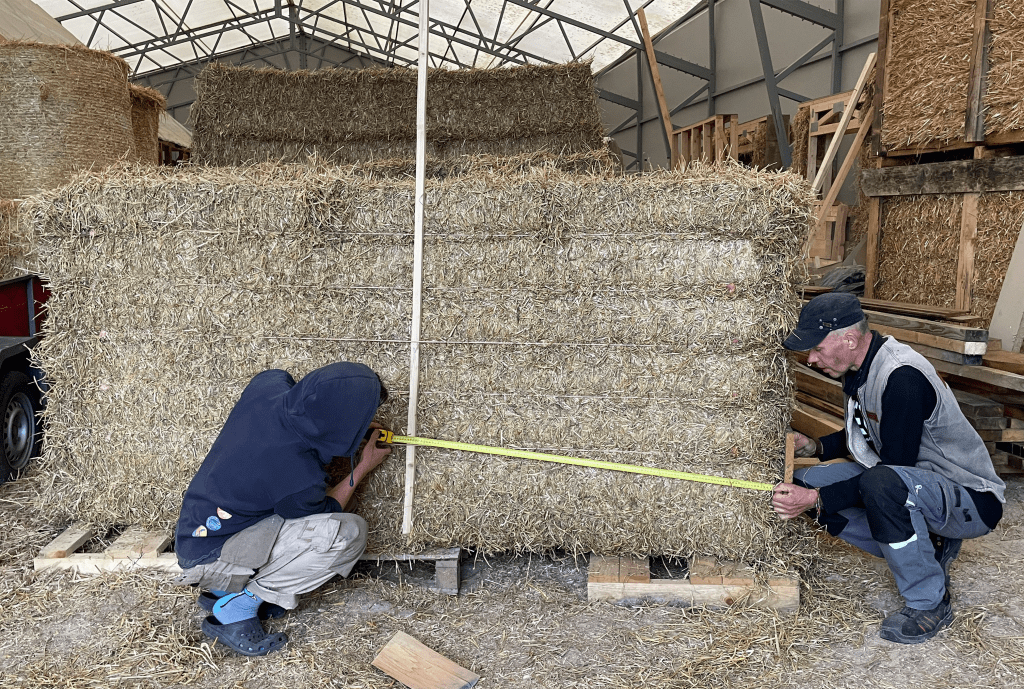
As the building permit took more than a year to obtain, the straw packs originally ordered had already found a new use. We therefore had to start reshape the available straw packs, which were significantly larger and heavier than the original design required. The first working day was mainly spent “sewing” and sawing these straw bales. Why? Since the bearing frame had already been built to the size of the originally planned straw bales, we had to reshape these large bales as required. We have to admit that this was a difficult job, and it is better to let the farmers make the straw bales of the right size, which are easy to install in the wall. This saves a lot of time and effort.
Construction of the base wall
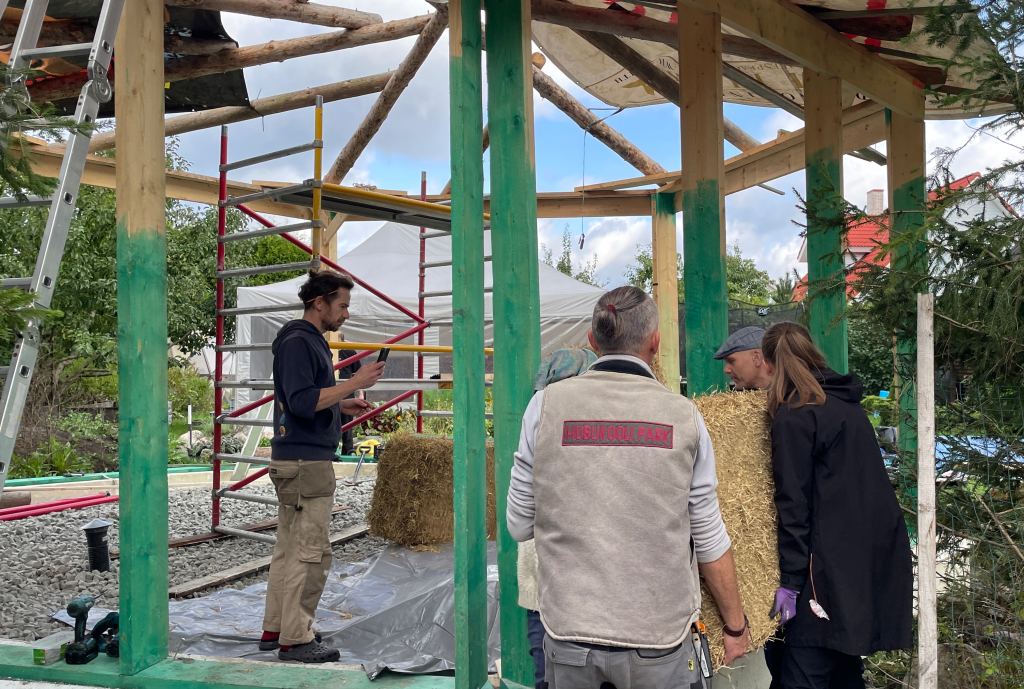
The next day was an exciting moment – the straw packs arrived in Viimsi from Central Estonia and Sven, the mentor, guided us through the installation. Although it is usually recommended to bring the straw packs to the construction site only after the roof was finished, our site only had the roof bearing frame. Luckily we had the sunny weather.
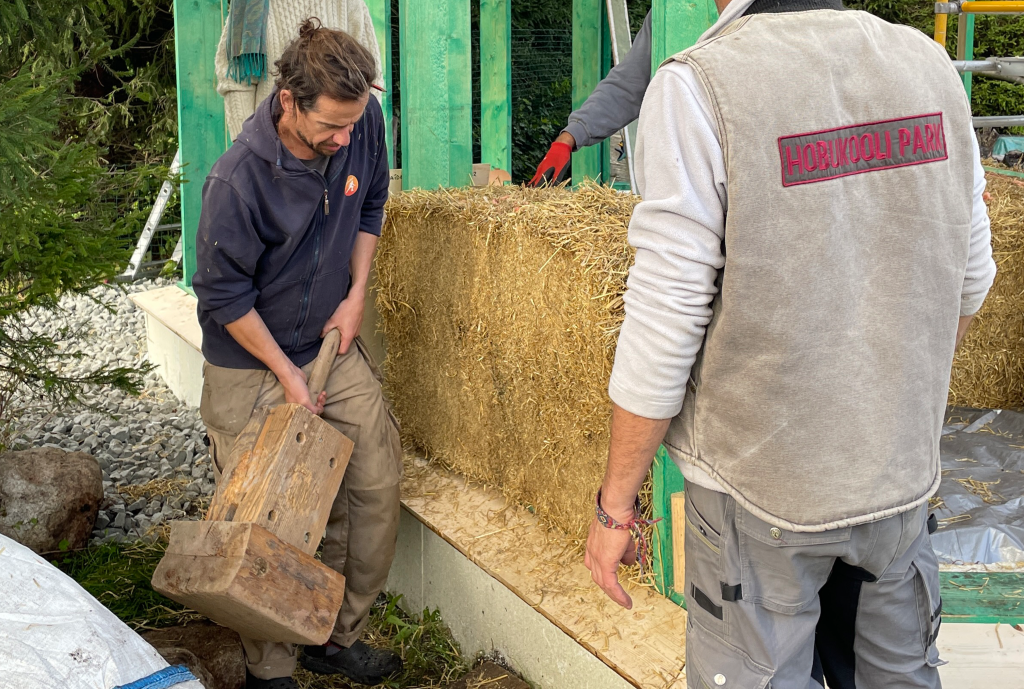
To install the straw package into the wall, we took the following steps. First, we covered important areas of the foundation to make sure the straw wouldn’t fall between the structure. Then we placed the 1200x400x700 mm straw pack into the wall and repositioned it in place with an “argument” (wooden tool). In order to ensure the stability of the straw pack in the wall, we cut two 5 cm deep grooves in the straw, where we put 21×45 mm wooden sprues, which were fixed to the frame. The straw bales were pressed together to minimise their sinking before fixing the sprues. The straw packs we used were particularly dense – 190 kg/m3, whereas the ideal density for construction is usually between 100 and 120 kg/m3.
The studio had a construction area of 20 m2 and was hexagonal in shape, with walls up to 2.8 m high. A total of 36 straw packs were installed on three walls. Windows and doors will be installed in the remaining walls, which will be covered with plaster. The final finishes will be revealed when the studio is completed. We look forward to seeing which ones the owner chooses!
In summary
All in all, our experience at the workshop was valuable. We have learned that building a straw house requires thorough preparation and accurate planning. One important lesson learned is that when you order the straw bales, allow the farmers to prepare them for you according to the dimensions you need. This saves time and energy and ensures that the construction process runs smoothly and efficiently. Also, when the main packages are delivered, a proper roof must be built, where the bales can be installed and stored in a moisture-proof manner.
Our team always strives to be exceptionally dynamic and participate in a wide range of courses and workshops. While there is a lot of valuable information to be found in books and online sources, the most in-depth knowledge can be gained through hands-on experience.
Estonian
Töötuba: Kuidas luua akustiliselt hea stuudio looduslike materjalidega?
Ühel sügisesel nädalavahetusel osalesime kahepäevasel põhumajaehituse koolitusel, mida korraldas LEIA (Loodusehituseakadeemia), mille asutajaks on Sven Aluste. Kursuse läbides saime õppida, kuidas luua puitkarkassi vahele väike-põhupakkidest seina ning seejuures katsetasime erinevaid põhumaja ehitustehnikaid, mida iga maja püstitamisel tarvis läheb. Nädalavahetus oli täis aktiivsust ja käed-küljes ülesandeid.
Ehituslik seiklus Viimsis
Koolituse praktiline osa toimus Viimsis, kus asus objekt, millele meie põhuseinu paigaldasime. Objektiks oli stuudio Viimsi elaniku koduhoovis, kus oli plaanis korraldada erinevaid tee- ja muusika tseremooniaid. Võibolla mõtlete, miks just põhust stuudio? Tellija eesmärk oli ehitada midagi erilist, huvitava vormiga maja ning samal ajal katsetada rohelisemat ehitustehnoloogiat.
Tellija jõudis põhuehituse ideeni läbi kahe olulise asjaolu. Esiteks soovis ta, et maja oleks erilise vormiga, midagi enamat kui tavaline nelinurkne ehitis. Teiseks tundis ta huvi keskkonnasõbralike ehitusmeetodite vastu. Oma kodutööd tehes tutvus ta põhuehitusega ja otsustas osaleda põhumajaehituse koolitusel. See koolitus tugevdas tema veendumust, et põhust seinad ja mandala katuse kombinatsioon on just see, mida ta vajab. Mandala on katus, mille puhul iga sarikas toetub eelmisele. Tulemuseks on tugev isekandev konstruktsioon.
Põhupaki jõud ja tulekindlus
Huvitavaks nüansiks selles projekti puhul oli, et peale koolitusel käimist rajas tellija vundamendi ja ehitas seina- ja katusekonstruktsioonid valmis. Seejärel ilmnes aga probleem – vallavalitsuselt ehitusloa saamine võttis kauem aega kui esialgu planeeritud. Probleem seisnes selles, et stuudio ja naabri kuuri tuleohutuskuja oli alla 8 meetri ning kehtivad eeskirjad nõudsid, et stuudio seinad peaksid olema tulekindlast materjalist.
Sellel aastal juhtus Põhukabeliga kohutav intsidendi. Nimelt süüdati Põhukabel 2023. aasta kevadel pahatahtlikult, mis uudistes kirjeldati täielikult hävinuna. Tegelikult põles kabeli puitkonstruktsioon ning kõik põhupakid olid säilinud, mis toimetati samale stuudio omaniku krundile. Stuudio ehitaja idee neid pakke taaskasutada. Antud juhtumist sai veenvaks argumendiks tuleohutuse spetsialistile, et põhust seinad on piisavalt tulekindlad.

Suured põhupakid ja nende töötlemine
Kuna ehitusluba võttis aega üle aasta, siis esialgsed tellitud põhupakid olid juba uue otstarbe leidnud. Seepärast pidime ümber töötlema saadaval olevaid põhupakke, mis olid märkimisväärselt suuremad ja raskemad kui algne projekt ette nägi. Esimene tööpäev kulus peamiselt nende põhupakkide “õmblemisele” ja saagimisele. Miks? Kuna karkass oli juba ehitatud vastavalt algselt planeeritud põhupakide suurusele, tuli meil kohapeal need suured pakid vastavalt vajadusele ümber kujundada. Peame tunnistama, et see oli üks tülikas töö ning parem on lasta põllumeestel valmis teha vastava suurusega põhupakid, mida on hea kohe seina paigaldada. See säästab palju aega ja vaeva.
Põhuseina ehitus
Järgmisel päeval saabus põnev hetk – põhupakid jõudsid Kesk-Eestist Viimsisse ning koolitaja Sven juhendas meid nende paigaldamisel. Kuigi tavaliselt soovitatakse põhupakid ehitusobjektile tuua alles pärast katuse lõplikku valmimist, oli meie objektil vaid katusekarkass olemas. Õnneks meil vedas päikselise ilmaga.
Põhupaki seina paigaldamiseks võtsime ette järgmised sammud. Esmalt katsime vundamendi olulised kohad, et põhk ei pudeneks konstruktsiooni vahele. Seejärel tõstsime 1200x400x700 mm suuruse põhupaki seina ning tagusime selle paika “argumendiga” (puidust tööriist). Põhupaki stabiilsuse tagamiseks seinas saagisime sisse kaks 5 cm sügavad sooned, kuhu paigaldasime 21×45 mm puitprussi, mis kinnitati karkassi külge. Enne prusside kinnitamist surusime põhupakid kokku, et vähendada nende vajumist. Põhupakid, mida kasutasime, olid eriti tihked – 190 kg/m3, samas kui ideaalne põhupaki tihedus ehituseks on tavaliselt vahemikus 100-120 kg/m3.
Stuudio ehitusalune pindala oli 20 m2 ja sellel oli kuusnurkne kuju, mille seinte kõrgus ulatus 2,8 meetrini. Kolmele seinale paigaldati kokku 36 põhupakki. Ülejäänud seintesse tulevad aknad ja uksed ning seinad kaetakse krohviga. Lõplikud viimistlused selguvad stuudio valmides. Jääme huviga ootama, millised omanik valib!

Kokkuvõtvalt
Lõppkokkuvõttes oli meie kogemus koolitusel väärtuslik. Oleme õppinud, et põhumajaehitus nõuab põhjalikku ettevalmistust ja täpset planeerimist. Üks oluline õppetund on, et kui tellite põhupakid, lubage põllumeestel need teie jaoks ette valmistada vastavalt vajalikele mõõtmetele. See hoiab kokku aega ja energiat ning tagab, et ehitusprotsess kulgeb sujuvalt ja tõhusalt. Samuti tuleb põhupakkide kohaletoomisel valmis ehitada korralik katus, kus saab niiskuskindlalt pakke seina paigaldada ja hoiustada.
Meie meeskond püüab alati olla erakordselt dünaamiline ja osaleda mitmesugustes koolitustes ning töötubades. Kuigi raamatutest ja veebiallikatest võib leida palju väärtuslikku
teavet, saab kõige sügavamaid teadmisi omandada läbi praktiliste kogemuste.
 1plussx